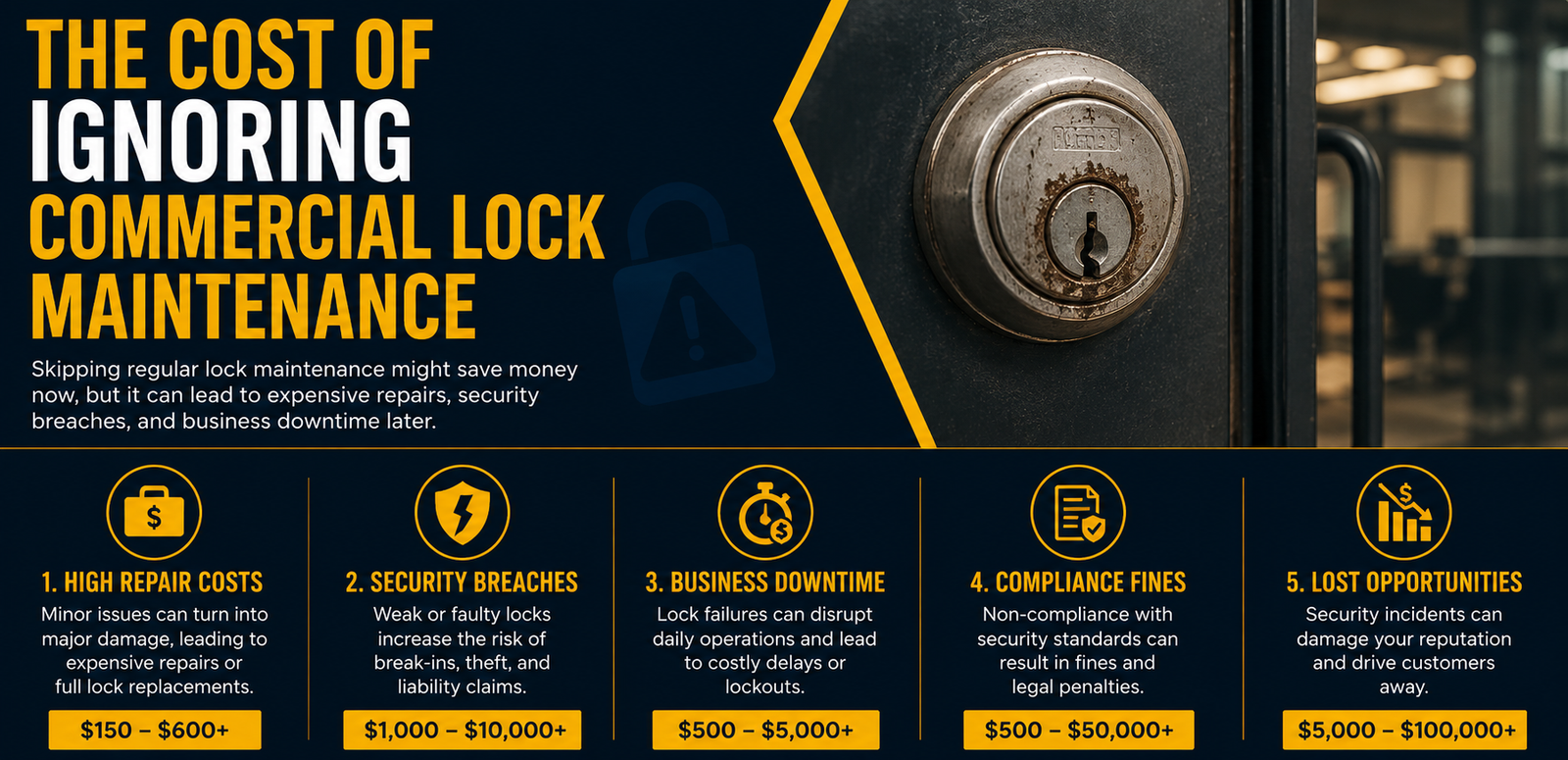

Ignoring commercial lock maintenance leads to break-ins, fire code violations, emergency lockout costs, and full lock replacements that cost far more than routine upkeep would have. DFW Affordable Locksmith LLC helps Garland businesses catch small lock problems before they turn into expensive security failures.
This guide explains what commercial lock maintenance includes, why skipping it is more costly than it looks, and how to build a maintenance plan around your building’s commercial door locks.
What Is Commercial Lock Maintenance?
Commercial lock maintenance is the routine inspection, cleaning, lubrication, and adjustment of every lock (security device) on a business property, done on a schedule rather than only after something breaks. It covers entry doors, interior offices, storerooms, and emergency exits.
A complete maintenance plan checks both mechanical hardware, like mortise and cylindrical locks, and electronic components on any keyless or access control systems in use.
Maintenance vs. Repair
Maintenance happens before a failure, through scheduled inspection and light upkeep like cleaning and lubricating locks. Repair happens after a failure, when a lock has already jammed, broken, or been compromised.
Why Does Ignoring Commercial Lock Maintenance Matter?
Skipping lock maintenance turns small, cheap problems into expensive emergencies, security breaches, and code violations. Garland’s humid climate accelerates hardware wear, which is one reason businesses need a commercial locksmith on a recurring basis, not just when something breaks.
A lock that isn’t maintained doesn’t fail quietly. It fails at the worst possible time, whether that’s during a break-in attempt, a fire evacuation, or an employee lockout that halts business operations.
What Neglect Actually Costs a Business
- Emergency locksmith calls, which cost more than scheduled service visits, especially for issues discovered outside business hours
- Full lock replacement after a lock cylinder seizes instead of a simple lubrication fix
- Security breaches from former employees whose access was never revoked
- Fire code violations from worn panic bar hardware on emergency exits
How Does a Commercial Lock Maintenance Plan Work?
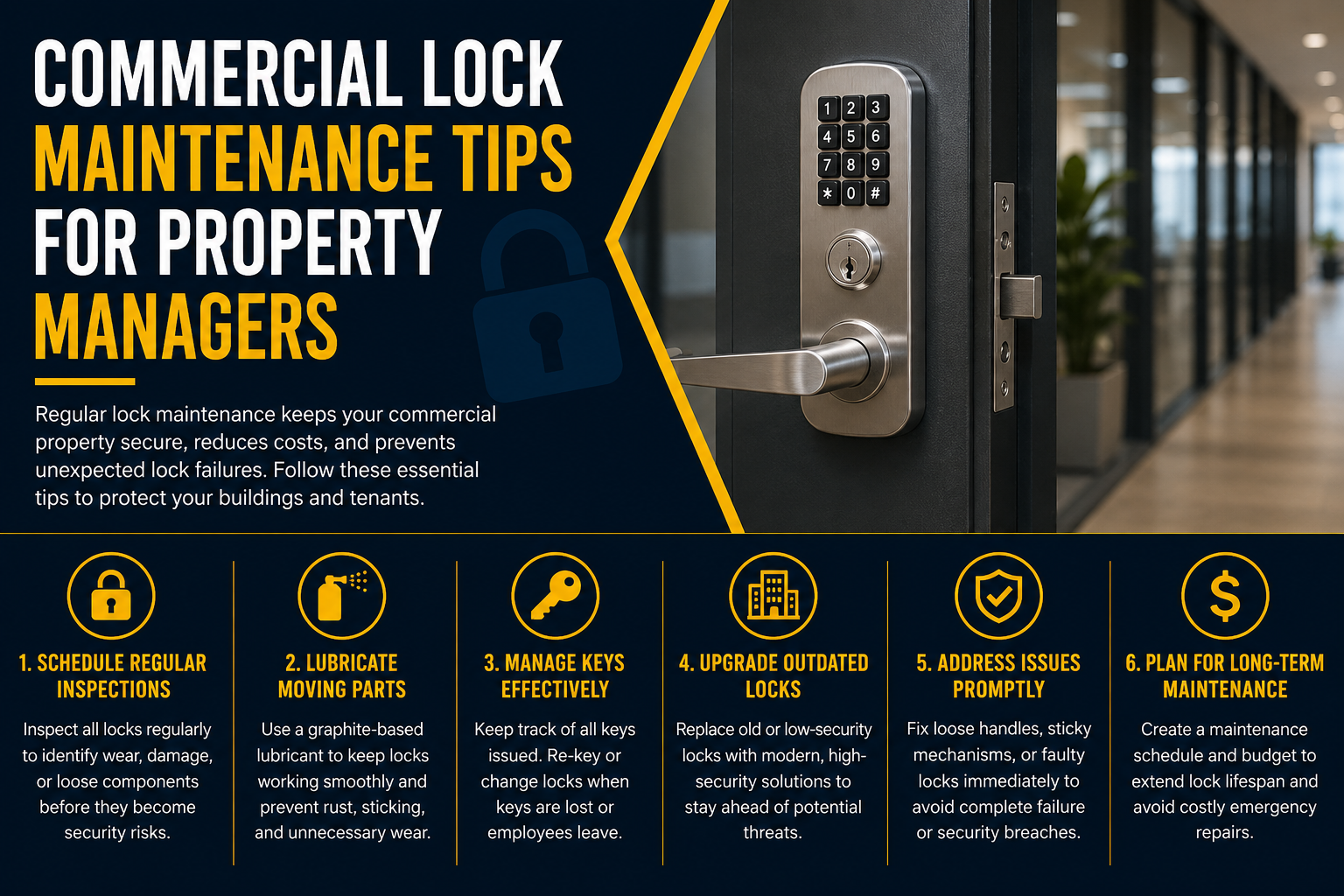
A proper maintenance plan inspects every lock on a fixed schedule, catching wear before it causes a failure or security gap.
- Full inventory: Document every lock, including entry doors, interior offices, and emergency exits.
- Scheduled inspection: Check each lock for wear, misalignment, and proper function on a recurring basis.
- Lubrication and cleaning: Clean internal mechanisms and apply appropriate lubricant to prevent sticking.
- Access review: Confirm keys, codes, or credentials match current employees and remove outdated access.
- Documentation: Keep records of inspections and repairs to track recurring issues over time.
Benefits of Regular Commercial Lock Maintenance
Routine maintenance prevents costly emergencies, keeps a business compliant with fire and safety codes, and extends the life of every lock on the property. Businesses using master key systems benefit even more, since a single overlooked key can affect access across an entire building.
- Lower long-term cost: Small fixes now instead of full replacements later
- Fewer emergency calls: Problems get caught during scheduled visits, not after a failure
- Better security: Outdated access is removed before it becomes a vulnerability
- Code compliance: Panic bars and emergency exits stay in working, inspection-ready condition
- Longer hardware life: Regular lubrication and cleaning slow down normal wear
Common Commercial Lock Maintenance Mistakes to Avoid
The most common mistake business owners make is waiting until a lock completely fails before calling a locksmith, instead of scheduling regular checkups. Similar concerns come up often in business security discussions about break-ins traced back to neglected hardware.
Warning Signs of Neglect
- A deadbolt misalignment that forces the door to be slammed or jiggled to lock
- A lock that won’t turn smoothly without extra force
- A history of keys breaking inside the lock, often a sign of internal wear
- Loose door hardware or latch alignment issues that go unaddressed
- Never rekeying after staff turnover, leaving old credentials active indefinitely
Commercial Lock Maintenance Cost vs. the Cost of Neglect
Routine maintenance costs a fraction of what a full commercial lock replacement or emergency repair costs after neglect leads to failure.
| Neglected Issue | Cost If Ignored | Cost of Routine Maintenance |
| Worn lock cylinder | Emergency lockout call plus full cylinder replacement | Scheduled cylinder inspection and lubrication |
| Deadbolt misalignment | Door left unsecured or damaged strike plate repair | Routine alignment check during a maintenance visit |
| Former employee key still active | Full rekey after a security incident | Scheduled rekeying as part of a maintenance plan |
| Panic bar hardware wear | Fire code violation and possible fines | Annual panic bar inspection and adjustment |
| Corroded exterior hardware | Full lock replacement after hardware seizes | Periodic cleaning and weatherproofing |
Comparing these two columns makes the case clearly: prevention is consistently the cheaper path, even before factoring in the cost of a security breach or lost business during downtime.
How to Choose the Right Commercial Lock Maintenance Provider
Choose a licensed commercial locksmith service that offers a recurring maintenance schedule, not just one-time emergency repairs.
- Scheduled service plans: Ask whether the provider offers recurring maintenance visits, not just on-call repairs
- Rekeying expertise: Understand the difference between rekeying and changing locks for staff turnover situations
- Electronic lock support: Confirm the provider services any keyless or access control hardware in use
- Fire code knowledge: Verify the provider understands panic bar and emergency exit requirements
- Local availability: A Garland-based team can respond quickly for both scheduled and emergency visits
DFW Affordable Locksmith LLC provides scheduled commercial lock maintenance plans for Garland businesses, alongside emergency repair and rekeying services when they’re needed.
Frequently Asked Questions
How often should commercial locks be inspected?
Most commercial properties benefit from a lock inspection at least once or twice a year, with high-traffic entry doors checked more frequently. Buildings with frequent staff turnover should also schedule a rekeying review annually.
What happens if a business ignores lock maintenance for years?
Neglected locks eventually fail, often at the worst possible time, and can lead to break-ins, fire code violations, or a costly full lock replacement instead of a simple repair.
Is rekeying or replacing locks better after an employee leaves?
In most cases, rekeying is faster and more affordable than full replacement, since it reuses the existing hardware. This rekeying vs. changing locks comparison explains when each option makes more sense.
Do electronic commercial locks need maintenance too?
Yes. Electronic and Wi-Fi or Bluetooth smart locks still need battery checks, firmware updates, and credential audits, in addition to the mechanical upkeep a traditional lock requires.
Can neglected panic bars cause a business to fail an inspection?
Yes. Fire and safety inspectors check that panic bar hardware on emergency exits functions correctly. Worn or misaligned panic bars can result in a failed inspection and required repairs before reopening.
Conclusion
Ignoring commercial lock maintenance almost always costs more than preventing the problem in the first place, whether that cost shows up as an emergency repair, a security breach, or a failed fire inspection. A scheduled maintenance plan protects the business on every front.
DFW Affordable Locksmith LLC helps Garland businesses build a commercial lock maintenance plan that prevents costly surprises. Contact DFW Affordable Locksmith LLC today to schedule a commercial lock inspection