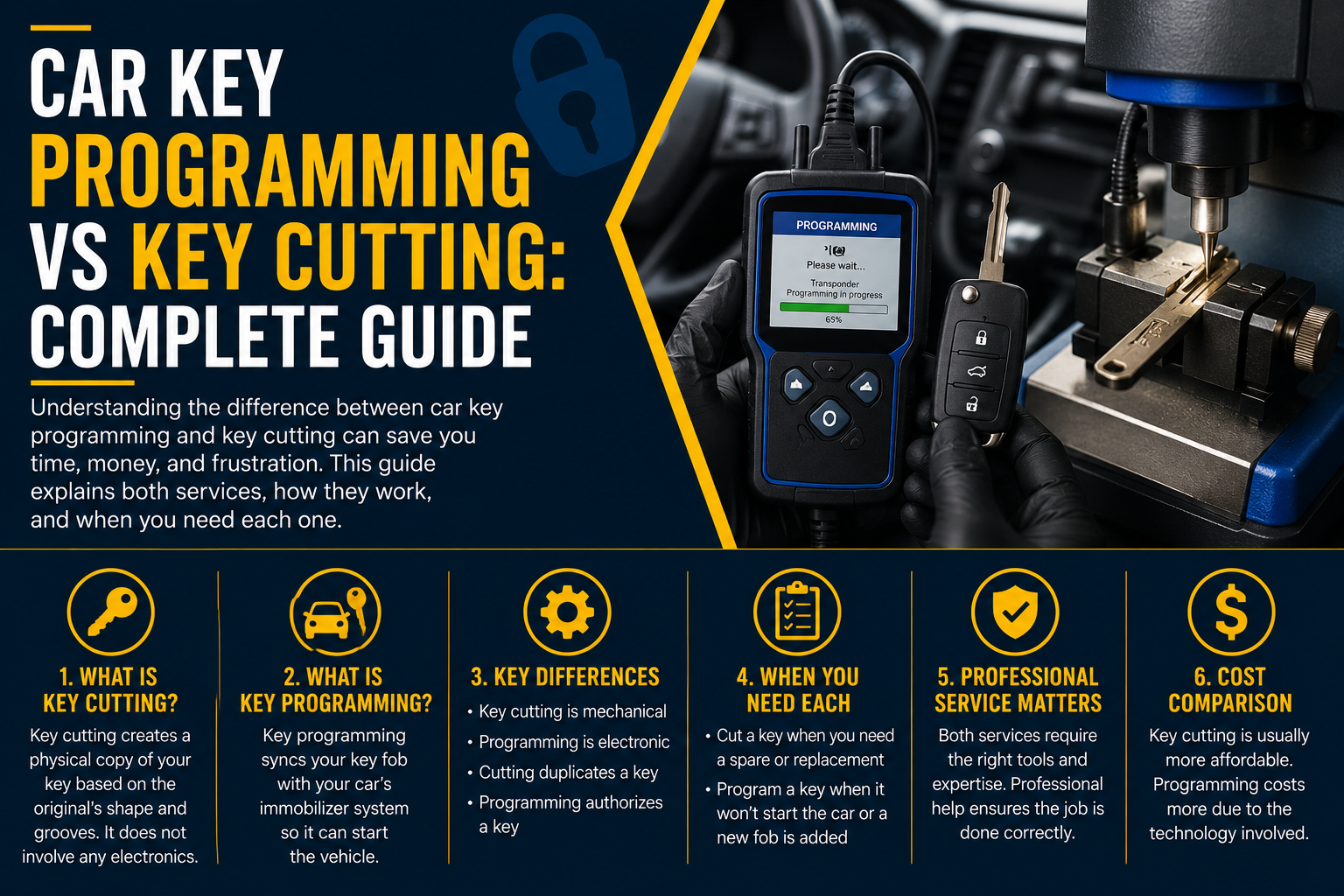

Losing a car key or needing a spare often leads to one important question: Do you need key cutting or key programming? While these terms are frequently used together, they refer to two completely different services.
Many modern vehicles require both a precisely cut key blade and electronic programming before the key can start the engine. Understanding the difference helps you avoid unnecessary costs, choose the right locksmith, and get back on the road faster.
In this guide, we’ll explain how car key programming and key cutting work, when each service is needed, their costs, and why professional locksmiths usually offer the fastest solution.
What Is Car Key Cutting?
Car key cutting is the process of creating the physical shape of a key so it fits into your vehicle’s lock and ignition.
Traditional keys have grooves and ridges that match the pins inside the lock. Modern laser-cut keys have more complex patterns that require specialized equipment.
A DFW Affordable Locksmith uses a key-cutting machine to duplicate an existing key or create a new one using the vehicle’s key code.
Key Cutting Is Used For
- Replacing lost keys
- Creating spare keys
- Worn or damaged keys
- Broken key replacement
- Door and ignition access
Key cutting only creates the physical key. It does not program the electronic chip inside the key.
What Is Car Key Programming?
Car key programming is the process of syncing a key’s electronic chip with your vehicle’s immobilizer system.
Most vehicles manufactured after the late 1990s include a security system that prevents unauthorized keys from starting the engine.
Even if a key is perfectly cut, the vehicle will not start unless the programmed transponder chip is recognized by the car’s computer.
Programming involves connecting specialized diagnostic equipment to the vehicle and registering the new key with the onboard system.
How Modern Car Keys Work
Today’s car keys are much more than pieces of metal.
A modern key usually contains three parts:
Mechanical Blade
This is the metal portion that physically unlocks the doors and turns the ignition.
Transponder Chip
A tiny electronic chip communicates with your vehicle’s immobilizer.
Without a recognized chip, the engine remains disabled.
Remote Key Fob
Many vehicles include buttons for:
- Locking doors
- Unlocking doors
- Opening the trunk
- Panic alarm
- Remote start
Each function may require programming separately.
Key Cutting vs Key Programming: The Main Differences
| Feature | Key Cutting | Key Programming |
| Creates physical key | ✔ | ✘ |
| Programs electronic chip | ✘ | ✔ |
| Allows key to fit lock | ✔ | ✘ |
| Allows engine to start | Only on older cars | ✔ |
| Requires cutting machine | ✔ | ✘ |
| Requires diagnostic software | ✘ | ✔ |
| Needed for modern vehicles | Usually | Almost always |
The biggest difference is simple:
When Do You Only Need Key Cutting?
Not every situation requires programming.
You may only need key cutting if:
- Your vehicle uses a traditional metal key.
- You need a duplicate house-style car key.
- Your existing key is bent or worn.
- Your older vehicle has no immobilizer system.
Classic cars and many vehicles manufactured before the late 1990s often only require key cutting.
When Do You Need Key Programming?
Programming becomes necessary when your vehicle uses electronic security systems. In these situations, Professional Automotive Locksmith Services in DFW can program new keys or key fobs to work correctly with your vehicle’s immobilizer and onboard security system.
Common situations include:
Lost All Keys
A locksmith must:
- Cut a new key
- Program the transponder
- Register it with the vehicle
Buying a New Key Fob
Replacement remotes usually require programming before they operate correctly.
Smart Key Replacement
Push-button start vehicles rely entirely on electronic communication.
Programming is essential.
Immobilizer Reset
Sometimes vehicle computers lose stored key information after battery or electrical issues.
The keys may need to be reprogrammed.
Vehicles That Usually Require Programming
Nearly every modern manufacturer uses transponder or smart key technology.
Examples include:
- Toyota
- Honda
- Ford
- Chevrolet
- Nissan
- Hyundai
- Kia
- BMW
- Mercedes-Benz
- Audi
- Volkswagen
- Lexus
- Subaru
- Mazda
Even within the same brand, programming procedures vary by model and year.
Types of Car Keys
Understanding your key type helps determine which service you need.
Traditional Metal Keys
These contain no electronics.
Only cutting is required.
Transponder Keys
These include a small electronic chip.
They require:
- Key cutting
- Chip programming
Flip Keys
Flip keys combine a folding blade with remote buttons.
They require:
- Blade cutting
- Remote programming
- Transponder programming
Smart Keys
Smart keys never enter the ignition.
Instead, the vehicle detects them wirelessly.
These require advanced programming and cannot simply be cut.
Can a Cut Key Start a Modern Car?
Usually not.
A locksmith may perfectly cut a replacement key, allowing it to unlock the doors.
However, without programming:
- The engine won’t crank.
- The immobilizer warning light may flash.
- The security system blocks ignition.
- Push-button start won’t detect the key.
The electronic chip is what authorizes the vehicle to start.
Can You Program a Key Yourself?
It depends on the vehicle.
Some older models allow owners to program new remotes using a sequence of:
- Turning the ignition
- Opening doors
- Pressing remote buttons
However, most modern vehicles require:
- Dealer-level diagnostic tools
- Manufacturer software
- Security PIN codes
- Professional programming equipment
DIY programming often doesn’t work for newer cars.
Why Professional Locksmiths Are the Better Choice
Many people assume dealerships are the only option.
In reality, professional automotive locksmiths often provide the same service with several advantages.
Faster Service
Many locksmiths offer same-day or emergency mobile service.
They come directly to your location.
Lower Cost
Dealerships typically charge more due to:
- Towing expenses
- Higher labor rates
- Longer wait times
Locksmiths usually provide a more affordable alternative.
On-Site Programming
Mobile locksmiths carry:
- Diagnostic computers
- Key cutting machines
- Programming devices
- Blank keys
- Replacement remotes
Everything is done where your vehicle is parked.
What Happens During Car Key Programming?
A typical programming appointment includes several steps.
Step 1: Vehicle Verification
The locksmith confirms ownership and identifies the vehicle.
Step 2: Key Cutting
If needed, a new mechanical blade is cut.
Step 3: Connect Diagnostic Equipment
The locksmith connects programming tools to the vehicle.
Step 4: Register the Key
The immobilizer system stores the new key information.
Step 5: Test All Functions
The locksmith checks:
- Door locks
- Ignition
- Engine start
- Remote buttons
- Trunk release
- Panic alarm
Everything is verified before completion.
Signs Your Key Needs Programming
You may need programming if:
- The key turns but the engine won’t start.
- The security light stays on.
- The remote buttons stop working.
- Push-button start says “No Key Detected.”
- You replaced your car battery and the key no longer works.
- You purchased a replacement key online.
These symptoms often indicate the vehicle no longer recognizes the electronic chip.
How Much Do These Services Cost?
Prices vary depending on the vehicle make, model, and key type.
Generally:
Key Cutting
- Traditional keys: Lower cost
- Laser-cut keys: Moderate cost
Key Programming
- Transponder keys: Moderate cost
- Remote keys: Higher cost
- Smart keys: Highest cost
Luxury vehicles typically require more advanced programming equipment, which can increase pricing.
How to Know Which Service You Need
Ask yourself these questions:
- Is your vehicle newer than the late 1990s?
- Does your key have remote buttons?
- Is it a push-button start vehicle?
- Does your key contain a transponder chip?
If you answered yes to any of these, you’ll likely need both key cutting and programming.
Frequently Asked Questions
Is key cutting the same as key programming?
No. Key cutting creates the physical key shape, while programming allows the vehicle’s computer to recognize the key and start the engine.
Can a locksmith program any car key?
Most professional automotive locksmiths can program keys for many makes and models using specialized diagnostic equipment. Some high-security or luxury vehicles may have additional restrictions.
Can I use a copied key without programming?
Only if your vehicle uses a traditional metal key without an immobilizer system. Most modern vehicles require programming.
Why won’t my new key start my car?
The key may be cut correctly but hasn’t been programmed to communicate with the vehicle’s immobilizer.
Is dealership programming better than a locksmith?
Not necessarily. Qualified automotive locksmiths often use professional-grade equipment and can provide the same programming services, frequently at a lower cost and with the convenience of mobile service.
Final Thoughts
Knowing the difference between car key programming and key cutting can save you time, money, and frustration. While key cutting creates a key that physically fits your vehicle, programming ensures the electronic security system recognizes it. For many modern cars, both services are essential.
If you’ve lost your keys, need a spare, or your vehicle no longer recognizes your key, working with an experienced automotive locksmith is often the fastest and most convenient solution. They can cut, program, and test your new key on-site, helping you get back behind the wheel without the hassle of towing your vehicle to a dealership.