
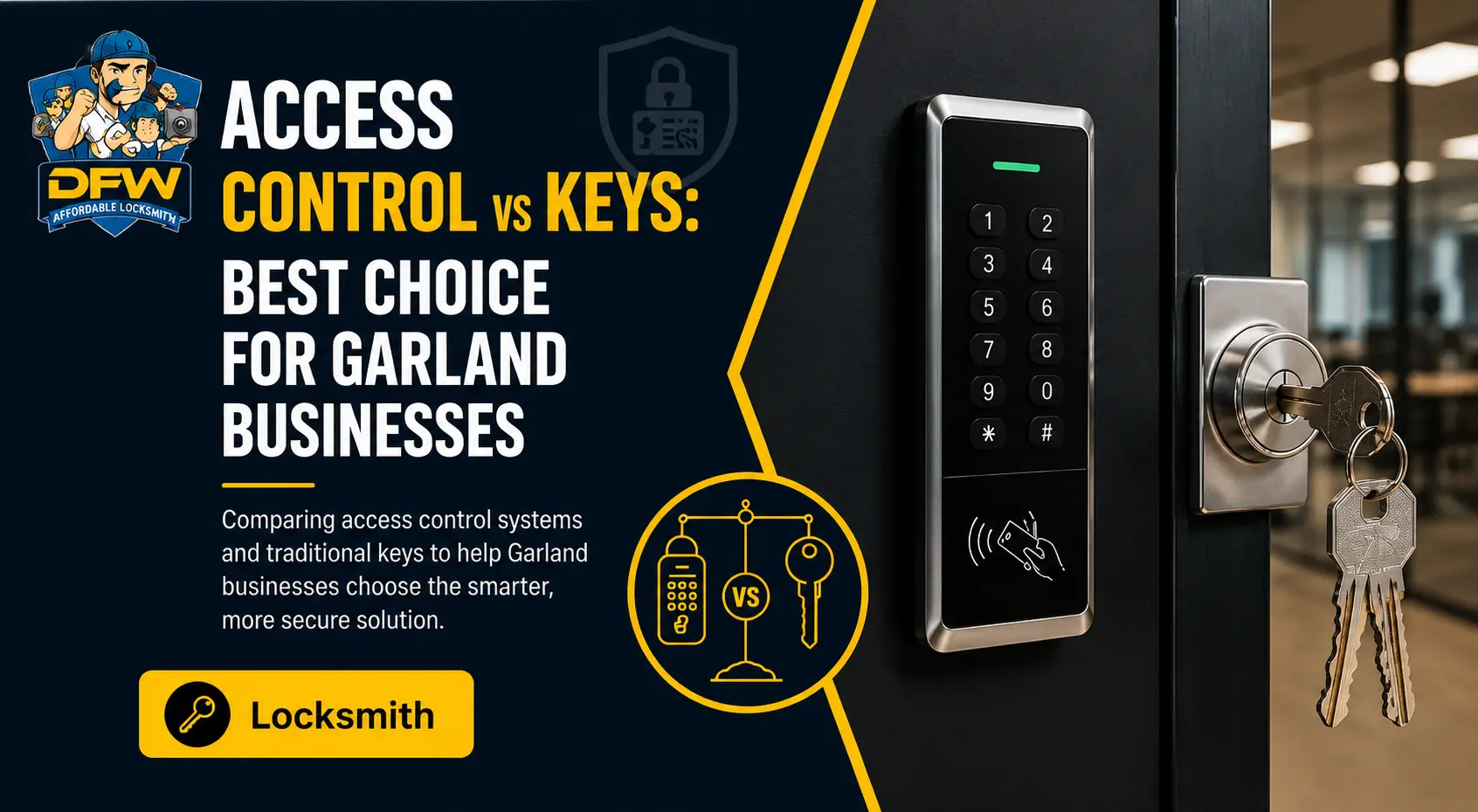

Access control systems are better for businesses that need to manage multiple employees, track entry activity, or change permissions quickly. Traditional keys still work well for small properties with few entry points and low turnover. The right choice depends on your building size, staff count, and how much control you need over who comes and goes.
This guide compares access control vs. keys across cost, security, convenience, and maintenance so Garland business owners can make an informed decision. You will also learn when a hybrid approach makes sense.
What Is the Difference Between Access Control and Keys?
Access control systems use key cards, fobs, codes, or mobile credentials to unlock doors electronically, while traditional key systems rely on a physical metal key cut to match a specific lock. Access control lets a business owner grant or remove entry permissions instantly from a computer or phone. A traditional key system requires a physical rekey or lock change to remove access. Business owners weighing their options can review commercial locksmiths in DFW to see the full range of security upgrades available beyond a simple lock swap.
Both systems secure a door, but they manage entry very differently. Keys are simple and mechanical. Access control is electronic and programmable.
Why Does Choosing the Right System Matter?
Choosing the right system matters because the wrong setup either wastes money on unnecessary technology or leaves a business exposed to preventable security risks.
A lost key on a traditional system means every affected lock may need to be rekeyed or replaced. Understanding the difference between rekeying vs changing a lock helps business owners see how quickly a simple key loss can turn into a bigger, more expensive job.
In Garland, businesses with employee turnover, multiple shifts, or shared office space often outgrow traditional keys faster than single tenant properties.
How Does Access Control Work Compared to Keys?
Access control systems work through electronic credentials that communicate with a locking mechanism, while key systems work through a mechanical fit between the key and lock cylinder.
- Credential assignment. Each employee receives a key card, fob, or code instead of a cut key.
- Access programming. The business owner sets which doors and hours each credential can unlock.
- Entry logging. The system records who entered and when, creating a digital activity trail.
- Instant revocation. Lost credentials get deactivated remotely without changing the physical lock.
5.Ongoing updates. Permissions adjust instantly as staff roles or schedules change.
Traditional keys skip all of this and rely on physical control instead. Comparing mechanical and electronic locks for DFW homes shows how the same trade offs apply to both residential and commercial properties.
Benefits of Access Control vs. Keys
Access control and traditional keys each offer distinct advantages depending on the property.
- Access control removes the need for rekeying after a lost credential
- Access control provides an entry log for accountability and audits
- Keys require no batteries, software, or network connection
- Keys cost less upfront for small properties with few doors
- Access control allows instant permission changes for staff turnover
- Access control supports scheduled access for cleaning crews or contractors
The right benefit list depends heavily on how many people need access and how often that access changes.
Common Mistakes When Choosing a Security System
The most common mistake is installing access control on a property that does not need it, which adds unnecessary cost and complexity for a small, low turnover business.
Another mistake is sticking with a basic key system after outgrowing it. According to the access control concept in general, the goal of any access system is limiting entry to authorized users only, and a business with frequent staff changes struggles to maintain that control with keys alone.
Some business owners also skip planning for power outages or system failures. A reliable access control setup should include a backup plan so doors are never fully inoperable during an outage.
Cost Factors for Access Control vs. Key Systems
Access control systems generally cost more upfront than key systems but can save money over time by eliminating repeated rekeying and lock changes.
Traditional key systems have lower installation costs but higher long term costs when keys are lost or employees leave. Reviewing commercial door lock replacement cost gives Garland business owners a clearer picture of what ongoing key based security actually costs over time.
How to Choose the Right System for Your Business
Choose access control if you have multiple employees, frequent staff turnover, or need to track who enters your building. Choose traditional keys if you run a small property with a stable, small team.
A hybrid approach also works well for many businesses, using access control on main entrances and traditional types of commercial door locks on lower risk interior doors.
Business owners comparing options often check community discussions for real world feedback, such as this access control vs. keys thread where property managers share what worked for their buildings.
DFW Affordable Locksmith LLC helps Garland businesses evaluate their current setup and install the right combination of access control and traditional locking hardware for their specific needs.
Frequently Asked Questions
Is access control better than traditional keys?
Access control is better for businesses with multiple employees or frequent staff changes, since it allows instant permission updates without rekeying. Traditional keys work well for small properties with a stable, low turnover team.
How much does access control cost compared to keys?
Access control systems cost more upfront than key systems, often due to hardware and software setup. Over time, access control can save money by avoiding repeated rekeying and lock replacement after lost keys.
Can I use both access control and keys in the same building?
Yes. Many businesses use a hybrid setup, placing access control on main entrances and traditional key locks on lower risk interior doors. This balances cost with the security level each area actually needs.
What happens if an access control system loses power?
Most commercial access control systems include battery backup or fail safe settings to prevent lockouts during a power outage. It is important to confirm this feature before installation.
Do small businesses need access control systems?
Not always. A small business with few employees and low turnover often does well with a traditional key system. Access control becomes more valuable as employee count and entry points increase.
How long does access control installation take?
Installation time depends on the number of doors and the complexity of the system. A single door setup may take a few hours, while a full building system can take one to several days to complete.
Conclusion
Access control and traditional keys both secure a property, but they fit very different business needs. Choose access control for growing teams and changing staff, and choose keys for smaller, stable properties. Contact DFW Affordable Locksmith LLC to get a professional recommendation for your Garland business.